
Your wood deck in Northville does not get an easy life. So when you start hunting for the best deck paint for wood, the honest answer has less to do with the can and more to do with the sky above it. That part gets skipped in most buying advice. The choice between oil-based vs water-based deck paint is not about which one wins in a lab. It is about which one survives a full Michigan year, where a board can swell on a humid August afternoon and freeze solid by November.
Here is what this article covers, and why it might push back on what you have read elsewhere. We will look at how Northville’s weather treats a painted deck, how each paint type holds up when boards expand and contract, and one question the comparison usually ignores. Every claim leans on weather data and on research from wood scientists, not on opinion. By the end, you will have a clear way to match a coating to your deck and your climate, plus a simple next step if you would rather hand the job to a crew that does this for a living.
Key Takeaways

Why Your Climate Decides the Winner
Northville falls inside what climate folks call a humid continental zone. In plain terms, that means four real seasons and a lot of movement across the freezing line. National Weather Service climate normals for the metro Detroit area show about 42 frosty days each year, with roughly 16 nights that drop to 10°F or colder. Summers swing the other way, with around 13 days reaching the 90s. Average humidity hovers near 75 percent.
That back-and-forth is the real stress on a deck. Researchers at the University of Michigan’s Great Lakes climate program track how often our region crosses the freeze-thaw line, and the count runs into the dozens in a typical year. Each cycle works like a tiny lever on your boards. Water soaks into the wood, freezes, expands, then thaws and shrinks. A deck does this over and over while also taking foot traffic, rain that pools on flat boards, and direct sun. A coating that cannot move with all of that will not last, no matter what the label promises.
So the question is not which paint is tougher on a test panel in a warehouse. The question is which one handles a surface that swells, shrinks, freezes, and bakes on repeat.
How Oil-Based vs Water-Based Deck Paint Behave in Freeze-Thaw
This is where the two paints split.
Water-based paint, usually an acrylic latex, stays flexible after it cures. It expands and contracts along with the wood underneath it. When a board grows on a humid day and shrinks on a cold one, the film stretches and relaxes with it. That flexibility is the single biggest reason most exterior crews now reach for acrylic latex first.
Oil-based paint behaves differently. It dries into a hard, rigid film. That hardness can feel like an advantage at first, and on a high-traffic stair tread it does resist scuffs well. But over the years, an oil film keeps hardening and turns brittle. A rigid film on a surface that keeps moving is a recipe for cracks. Once water gets into those cracks, it sits between the paint and the wood, and the freeze-thaw cycle starts prying the coating loose. Home repair resource Bob Vila notes the same pattern: latex flexes with the surface, while oil-based paint does not, which can show up as cracks and blisters that trap moisture.
There is a trade-off in the other direction, too. Oil-based paint resists abrasion and holds a smooth look longer in spots that get scuffed. So if your deck is mostly a low-traffic seating area in a shaded yard, an oil coating may hold its finish. But for a sunny, walked-on deck in a freeze-thaw climate, flexibility tends to matter more than hardness.
The Question the Comparison Usually Skips
Here is the part most articles will not tell you. Before you settle the oil-based vs water-based deck paint debate, ask whether a film-forming paint belongs on a walking surface at all.
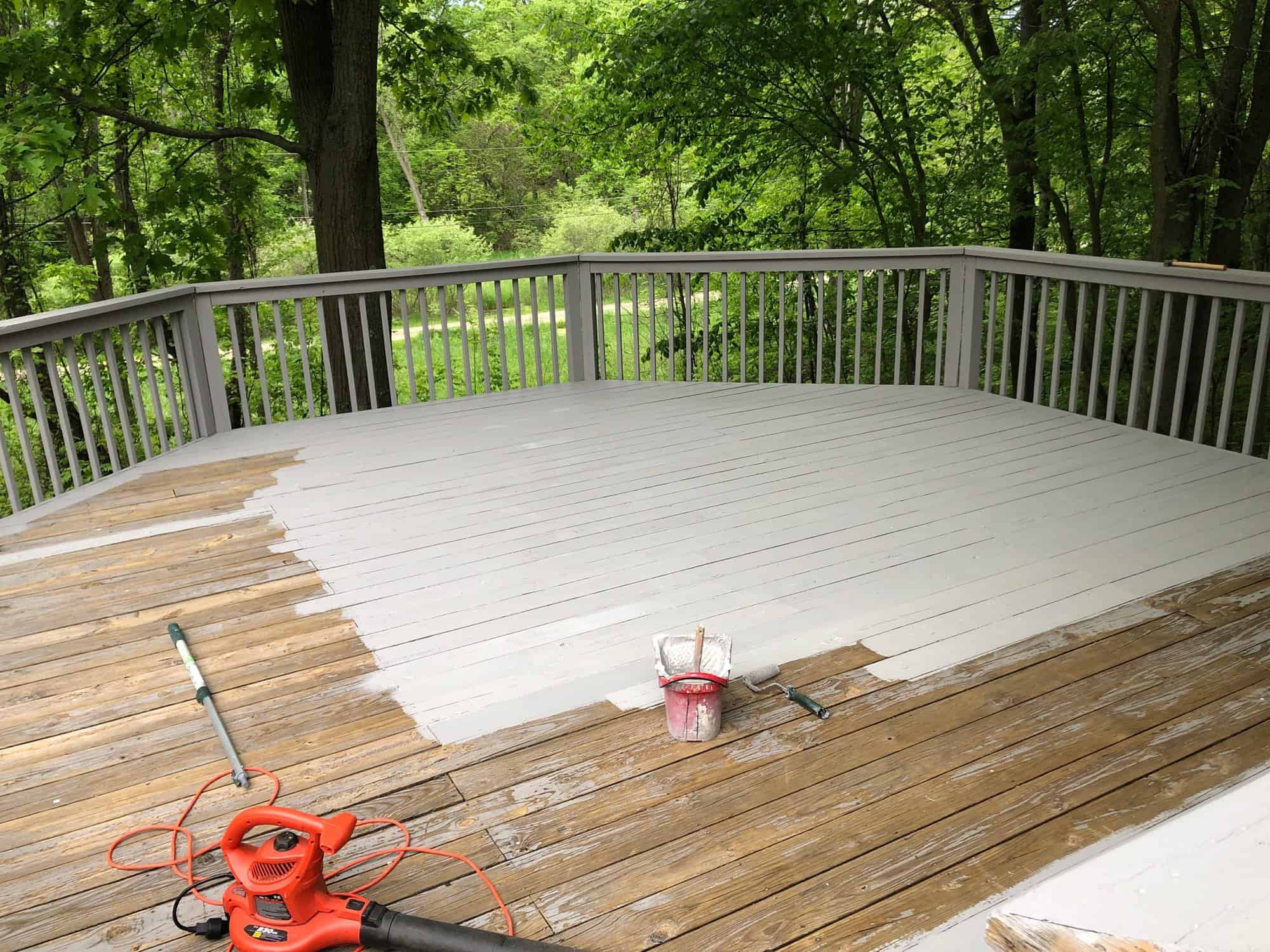
The USDA Forest Products Laboratory, the federal government’s wood research lab, has studied this for decades. Their finding is plain. On wood that sits out in full weather, a paint film slows the wood’s ability to dry, so moisture can get trapped underneath. On flat deck boards that take sun and standing water, film-forming finishes are prone to cracking and flaking. Penetrating finishes, like semitransparent stains and water-repellent treatments, soak into the wood instead of sitting on top. They wear thinner over time, but you can refresh them by brushing on another coat. No scraping. No sanding down to bare board.
That does not make paint the wrong choice. A solid-color deck paint hides gray, weathered wood and gives you a clean, even color that a stain cannot match. Plenty of homeowners want that look and accept the upkeep. The point is honesty. If you mainly care about long life and low fuss on a horizontal surface, a penetrating finish deserves a fair look next to paint. If color and full coverage rank higher for you, paint is a fine pick, and a flexible water-based product gives you the better odds in Northville.
Timing Matters as Much as the Can
Even the right product fails if you apply it at the wrong time. Water-based deck coatings need warmth to cure correctly. Sherwin-Williams’ application guidance points to 50°F as the standard floor, with the surface staying above that mark and above the dew point for a day or more after you finish. Some cold-weather formulas can go down to 35°F, which can stretch your window by a few weeks on each end of the season.
In Michigan, that window is tight. You are working with late spring through early fall for most products, and you want a dry stretch with no overnight chill creeping in. Paint a deck too late in October and a sudden cold night can wreck the cure before the film ever forms. This is also why a rushed weekend project sometimes peels by the next summer. The paint never got the conditions it needed.
For reference, deck paint generally runs about $40 to $150 a gallon, so the product itself is rarely the biggest cost. The labor, the prep, and the do-over if it fails are what add up.
A Simple Plan for Choosing
You do not need a chemistry degree to get this right. Four steps cover it.
Run those four steps and you avoid the outcome nobody wants: a deck that looks great in June and peels by the following spring, sending you back to the scraper.
Talk to a Crew That Coats Decks Through Michigan Winters
You can sort through paint cans, temperature charts, and freeze-thaw data on your own. Many homeowners do. But the cost of guessing wrong is a full re-do, and a deck only gives you a few good weeks a year to get it right.
That is where J&B Painting comes in. We coat wood decks across Northville and the surrounding area, and we match the product to your deck’s exposure, your wood, and the calendar so the finish has a real chance to last. We will walk your deck, tell you straight whether paint or a penetrating finish fits your situation, and put the recommendation in writing before any work starts.
Call J&B Painting at 248-629-2458 for a deck assessment. Bring your questions about oil-based vs water-based deck paint, and you will leave the conversation knowing exactly what your deck needs and why. Before the next freeze, get a plan that holds up.